Background
Today, we do not enforce determinism for contract verification in Corda, and this works just fine because current deployments tend to expect all participants to collaborate on updates to the ledger. By extension of this collaborative nature, we rely on the app developers to ensure that contracts verify ledger transactions in a reasonable way. However, the DJVM feature outlined in this post will allow for significantly more sophisticated scenarios in more adversarial threat environments.
Other points worth mentioning is that due to Corda’s unique architecture, most of the logic does in fact not need to be run deterministically. This means that you have access to the full power of the JVM and the Java ecosystem when writing your apps. The area where determinism is needed — verification of proposed updates to the ledger — is a very small and self-contained area. In other words, you do not get forced into the deterministic straitjacket for your entire app unlike some of the take-it-or-leave-it approached platforms.
Introduction
The code in the DJVM module has not yet been integrated with the rest of the platform. It will eventually become a part of the node and enforce deterministic and secure execution of smart contract code, which is mobile and may propagate around the network without human intervention.
Currently, it stands alone as an evaluation version. We want to give developers the ability to start trying it out and get used to developing deterministic code under the set of constraints that we envision will be placed on contract code in the future.
Note : The deterministic sandbox is currently a standalone evaluation version of what we, in the future, want to integrate with the Corda platform to protect execution of contract code and ensure deterministic behaviour.
Motivation and Overview
It is important that all nodes that process a transaction always agree on whether it is valid or not. Because transaction types are defined using JVM byte code, this means that the execution of that byte code must be fully deterministic. Out of the box a standard JVM is not fully deterministic, thus we must make some modifications in order to satisfy our requirements.
So, what does it mean for a piece of code to be fully deterministic? Ultimately, it means that the code, when viewed as a function, is pure. In other words, given the same set of inputs, it will always produce the same set of outputs without inflicting any side-effects that might later affect the computation.
Non-Determinism
For a program running on the JVM, non-determinism could be introduced by a range of sources, for instance:
- External input, e.g., the file system, network, system properties and clocks.
- Random number generators.
- Halting criteria, e.g., different decisions about when to terminate long running programs.
- Hash-codes, or more specifically
Object.hashCode(), which is typically implemented either by returning a pointer address or by assigning the object a random number. This could, for instance, surface as different iteration orders over hash maps and hash sets, or be used as non-pure input into arbitrary expressions. - Differences in hardware floating point arithmetic.
- Multi-threading and consequent differences in scheduling strategies, affinity, etc.
- Differences in API implementations between nodes.
- Garbage collector callbacks.
To ensure that the contract verification function is fully pure even in the face of infinite loops we want to use a custom-built JVM sandbox. The sandbox performs static analysis of loaded byte code and a rewriting pass to allow for necessary instrumentation and constraint hardening.
The byte code rewriting further allows us to patch up and control the default behaviour of things like the hash-code generation for java.lang.Object. Contract code is rewritten the first time it needs to be executed and then stored for future use.
Abstraction
The sandbox is abstracted away as an executor which takes as input an implementation of the interface SandboxedRunnable<in Input, out Output>, dereferenced by a ClassSource. This interface has a single method that needs implementing, namely run(Input): Output.
A ClassSource object referencing such an implementation can be passed into the SandboxExecutor<in Input, out Output>together with an input of type Input. The executor has operations for both execution and static validation, namely run() and validate(). These methods both return a summary object.
In the case of execution, this summary object has information about:
- Whether or not the runnable was successfully executed.
- If successful, the return value of
SandboxedRunnable.run(). - If failed, the exception that was raised.
- And in both cases, a summary of all accrued costs during execution.
For validation, the summary contains:
- A type hierarchy of classes and interfaces loaded and touched by the sandbox’s class loader during analysis, each of which contain information about the respective transformations applied as well as meta-data about the types themselves and all references made from said classes.
- A list of messages generated during the analysis. These can be of different severity, and only messages of severity
ERRORwill prevent execution.
The sandbox has a configuration that applies to the execution of a specific runnable. This configuration, on a higher level, contains a set of rules, definition providers, emitters and a whitelist.
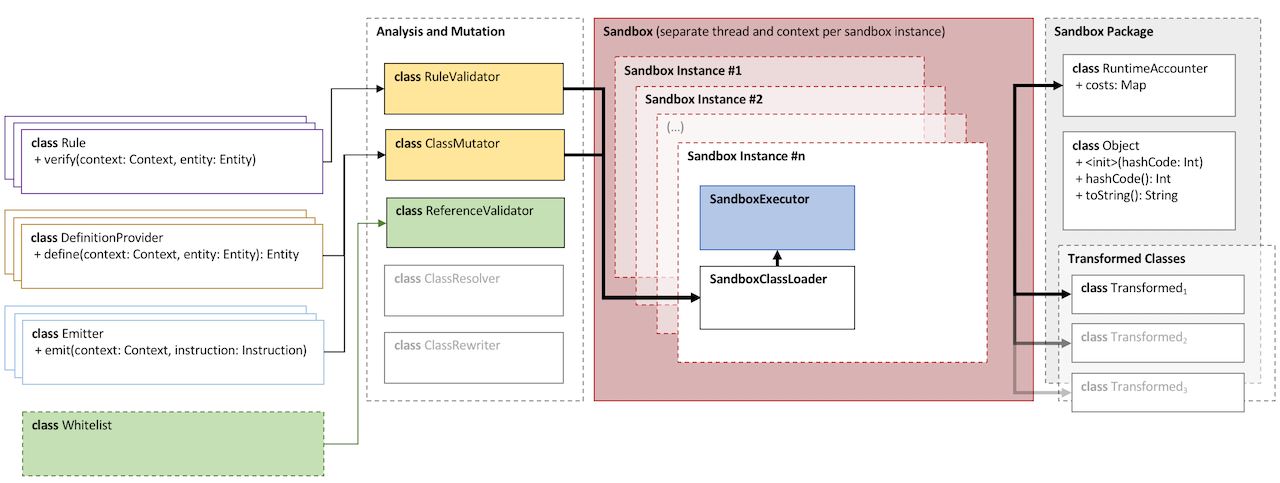
The set of rules is what defines the constraints posed on the runtime environment. A rule can act on three different levels, namely on a type-, member- or instruction-level. The set of rules get processed and validated by the RuleValidator prior to execution.
Similarly, there is a set of definition providers which can be used to modify the definition of either a type or a type’s members. This is what controls things like ensuring that all methods implement strict floating point arithmetic, and normalisation of synchronised methods.
Lastly, there is a set of emitters. These are used to instrument the byte code for cost accounting purposes, and also to inject code for checks that we want to perform at runtime or modifications to out-of-the-box behaviour.
Static Byte Code Analysis
In summary, the byte code analysis currently performs the following checks. This is not an exhaustive list as further work may well introduce additional constraints that we would want to place on the sandbox environment.
Note : It is worth noting that not only smart contract code is instrumented by the sandbox, but all code that it can transitively reach. In particular this means that the Java runtime classes (that have not been whitelisted) and any other library code used in the program are also instrumented and persisted ahead of time.
Disallow Catching ThreadDeath Exception
Prevents exception handlers from catching ThreadDeath exceptions. If the developer attempts to catch an Error or a Throwable(both being transitive parent types of ThreadDeath), an explicit check will be injected into the byte code to verify that exceptions that are trying to kill the current thread are not being silenced. Consequently, the user will not be able to bypass an exit signal.

Disallow Catching ThresholdViolationException
The ThresholdViolationException is, as the name suggests, used to signal to the sandbox that a cost tracked by the runtime cost accountant has been breached. For obvious reasons, the sandbox needs to protect against user code that tries to catch such exceptions, as doing so would allow the user to bypass the thresholds set out in the execution profile.
Only Allow Explicitly Whitelisted Runtime API
Ensures that constant pool references are mapped against a verified subset of the Java runtime libraries. Said subset excludes functionality that contract code should not have access to, such as file I/O or external entropy. In future versions, this whitelist will be trimmed down to the bare minimum needed so that also the Java runtime libraries themselves will be subjected to the same amount of scrutiny that the rest of the code is at the moment.

Warning : Currently, the surface of the whitelist is quite broad and is also incorporating the standard libraries for Kotlin. This will be stripped down in the future.
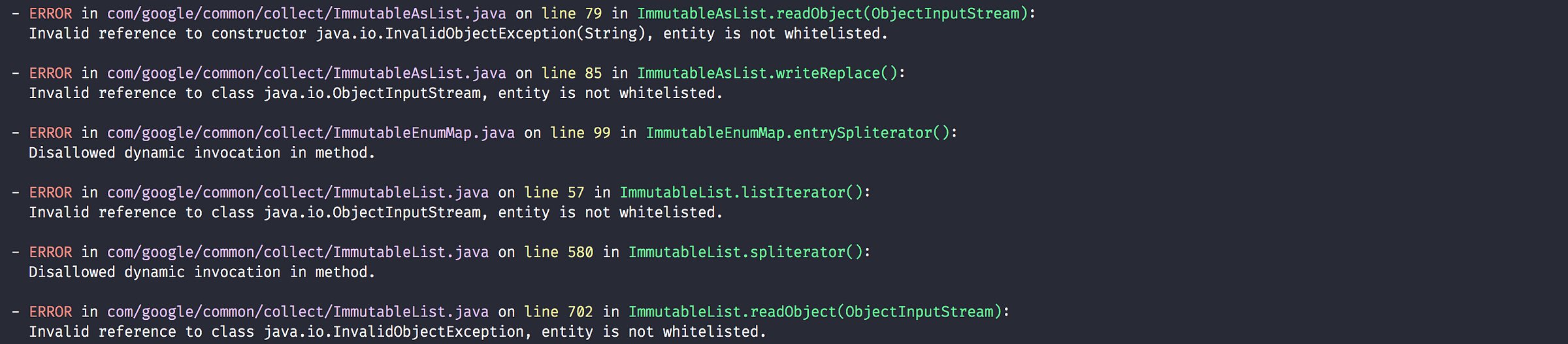
Disallow Dynamic Invocation
Forbids invokedynamic byte code as the libraries that support this functionality have historically had security problems and it is primarily needed only by scripting languages. In the future, this constraint will be eased to allow for dynamic invocation in the specific lambda and string concatenation meta-factories used by Java code itself.
Disallow Native Methods
Forbids native methods as these provide the user access into operating system functionality such as file handling, network requests, general hardware interaction, threading, etc. These all constitute sources of non-determinism, and allowing such code to be called arbitrarily from the JVM would require deterministic guarantees on the native machine code level. This falls out of scope for the DJVM.
Java runtime classes that call into native code and that are needed from within the sandbox environment, can be whitelisted explicitly.

Disallow Finalizer Methods
Forbids finalizers as these can be called at unpredictable times during execution, given that their invocation is controlled by the garbage collector. As stated in the standard Java documentation:
Called by the garbage collector on an object when garbage collection determines that there are no more references to the object.
Disallow Overridden Sandbox Package
Forbids attempts to override rewritten classes. For instance, loading a class com.foo.Bar into the sandbox, analyses it, rewrites it and places it into sandbox.com.foo.Bar. Attempts to place originating classes in the top-level sandbox package will therefore fail as this poses a security risk. Doing so would essentially bypass rule validation and instrumentation.
Disallow Breakpoints
For obvious reasons, the breakpoint operation code is forbidden as this can be exploited to unpredictably suspend code execution and consequently interfere with any time bounds placed on the execution.
Disallow Reflection
For now, the use of reflection APIs is forbidden as the unmanaged use of these can provide means of breaking out of the protected sandbox environment.
Disallow Unsupported API Versions
Ensures that loaded classes are targeting an API version between 1.5 and 1.8 (inclusive). This is merely to limit the breadth of APIs from the standard runtime that needs auditing.
Runtime Costing
The runtime accountant inserts calls to an accounting object before expensive byte code. The goal of this rewrite is to deterministically terminate code that has run for an unacceptably long amount of time or used an unacceptable amount of memory. Types of expensive byte code include method invocation, memory allocation, branching and exception throwing.
The cost instrumentation strategy used is a simple one: just counting byte code that are known to be expensive to execute. The methods can be limited in size and jumps count towards the costing budget, allowing us to determine a consistent halting criteria. However it is still possible to construct byte code sequences by hand that take excessive amounts of time to execute. The cost instrumentation is designed to ensure that infinite loops are terminated and that if the cost of verifying a transaction becomes unexpectedly large (e.g., contains algorithms with complexity exponential in transaction size) that all nodes agree precisely on when to quit. It is not intended as a protection against denial of service attacks. If a node is sending you transactions that appear designed to simply waste your CPU time then simply blocking that node is sufficient to solve the problem, given the lack of global broadcast.
The budgets are separate per operation code type, so there is no unified cost model. Additionally the instrumentation is high overhead. A more sophisticated design would be to statically calculate byte code costs as much as possible ahead of time, by instrumenting only the entry point of ‘accounting blocks’, i.e., runs of basic blocks that end with either a method return or a backwards jump. Because only an abstract cost matters (this is not a profiler tool) and because the limits are expected to bet set relatively high, there is no need to instrument every basic block. Using the max of both sides of a branch is sufficient when neither branch target contains a backwards jump. This sort of design will be investigated if the per category budget accounting turns out to be insufficient.
A further complexity comes from the need to constrain memory usage. The sandbox imposes a quota on bytes allocated rather than bytes retained in order to simplify the implementation. This strategy is unnecessarily harsh on smart contracts that churn large quantities of garbage yet have relatively small peak heap sizes and, again, it may be that in practice a more sophisticated strategy that integrates with the garbage collector is required in order to set quotas to a usefully generic level.
Note : The current thresholds have been set arbitrarily for demonstration purposes and should not be relied upon as sensible defaults in a production environment.
Instrumentation and Rewriting
Always Use Strict Floating Point Arithmetic
Sets the strictfp flag on all methods, which requires the JVM to do floating point arithmetic in a hardware independent fashion. Whilst we anticipate that floating point arithmetic is unlikely to feature in most smart contracts (big integer and big decimal libraries are available), it is available for those who want to use it.

Always Use Exact Math
Replaces integer and long addition and multiplication with calls to Math.addExact()and Math.multiplyExact, respectively. Further work can be done to implement exact operations for increments, decrements and subtractions as well. These calls into java.lang.Mathessentially implement checked arithmetic over integers, which will throw an exception if the operation overflows.

Always Inherit From Sandboxed Object
As mentioned further up, Object.hashCode() is typically implemented using either the memory address of the object or a random number; which are both non-deterministic. The DJVM shields the runtime from this source of non-determinism by rewriting all classes that inherit from java.lang.Object to derive from sandbox.java.lang.Object instead. This sandboxed Object implementation takes a hash-code as an input argument to the primary constructor, persists it and returns the value from the hashCode() method implementation. It also has an overridden implementation of toString().

The loaded classes are further rewritten in two ways:
- All allocations of new objects of type
java.lang.Objectget mapped into using the sandboxed object. - Calls to the constructor of
java.lang.Objectget mapped to the constructor ofsandbox.java.lang.Objectinstead, passing in a constant value for now. In the future, we can easily have this passed-in hash-code be a pseudo random number seeded with, for instance, the hash of the transaction or some other dynamic value, provided of course that it is deterministically derived.
Disable Synchronised Methods and Blocks
Since Java’s multi-threading API has been excluded from the whitelist, synchronised methods and code blocks have little use in sandboxed code. Consequently, we log informational messages about occurrences of this in your sandboxed code and automatically transform them into ordinary methods and code blocks instead.
Try It Out?
As mentioned in my previous post, the work is currently up for review here. If you want to take it for a spin, simply clone the repository, check out the tlil/deterministic-jvm branch and run the command install script from the djvm sub-directory.
Future Work
Some of the follow-up work that is currently planned is:
- To enable controlled use of reflection APIs.
- Strip out the dependency on the extensive whitelist of underlying Java runtime classes.
- Currently, dynamic invocation is disallowed. Allow specific lambda and string concatenation meta-factories used by Java code itself.
- Map more mathematical operations to use their ‘exact’ counterparts.
- General tightening of the enforced constraints.
- Cost accounting of runtime metrics such as memory allocation, branching and exception handling. More specifically defining sensible runtime thresholds and make further improvements to the instrumentation.
- More sophisticated runtime accounting as discussed in the Runtime Costing section.
